Understanding Aviator Round Mechanics
Spribe's Aviator is a crash-style game where each round produces a random multiplier. The on-screen aircraft climbs and the multiplier rises until it "crashes" at a value determined by a certified random number generator (RNG). Your job is to cash out before the crash if you want to lock in a profit.
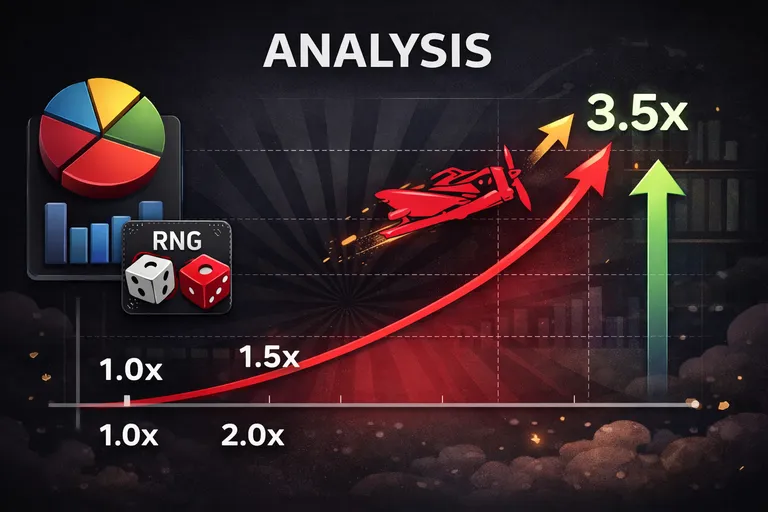
Round outcomes are independent: one round might end at 1.43x, the next at 2.10x, another at 3.50x. There is no pattern or predictable sequence. Analysing past rounds does not improve your odds in future rounds, but understanding the maths helps you set realistic expectations and manage your bankroll.
Outcome Comparison: Win, Loss and Tie
Every round fits one of three outcomes. The table below summarises what happens in each case.
| Scenario | Your bet | Result | Outcome |
|---|---|---|---|
| Win | You expect at least 1.60x | Round reaches 2.10x | You cash out in time and profit (e.g. +0.60 on 1 unit) |
| Loss | You aim for 2.50x | Round crashes at 1.23x | You lose the stake |
| Tie | You cash out at 1.50x | Round crashes at 1.50x | Stake returned, no gain or loss |
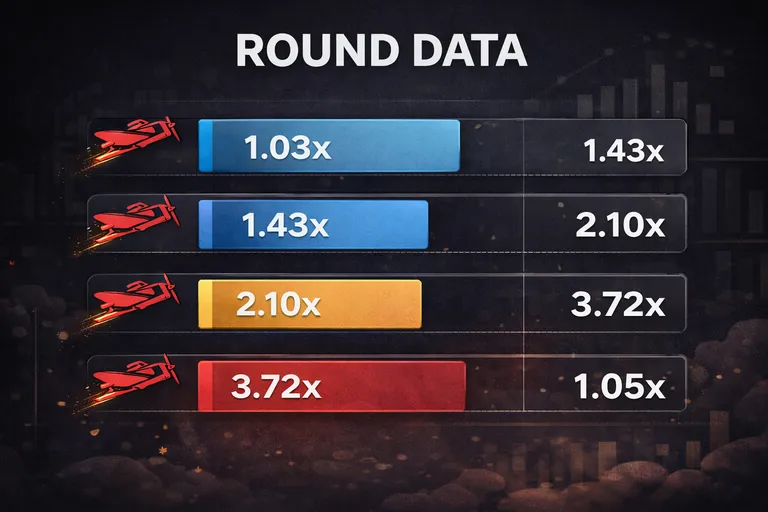
Mathematical and Data Perspective
From a mathematical standpoint, the game is designed with a house edge (typically around 1% in fair implementations). Over a large number of bets, the operator retains a small percentage.
Aviator vs Other Casino Games
| Factor | Aviator (crash) | Slots | Roulette |
|---|---|---|---|
| House edge | ~1% | ~2–5% | ~2.7% (EU) |
| Round speed | Very fast (seconds) | Medium | Slower |
| Player control | When to cash out | None after spin | Bet placement only |
| Provably fair | Yes (Spribe) | Rare | No |
Analytics and "Aviator analysis" tools that show round history are useful for transparency and fun, but they cannot predict the next multiplier. Always play on licensed sites that use audited RNG and display provably fair data where available.
Conclusion and FAQ
Use this guide to interpret Aviator analytics and round data sensibly. Focus on licensed casinos, clear terms, and responsible limits rather than chasing patterns that do not exist.
What is the house edge in Aviator? In a standard implementation the house edge is about 1%, meaning over time the operator keeps roughly 1 unit per 100 wagered.
How do I read Aviator rounds? The RNG decides the crash point each round. The rising multiplier represents potential payout; cashing out before the crash locks in that multiplier. There is no way to know the crash point in advance.
Can I always win in Aviator? No. Outcomes are random. You can improve your experience by setting limits and treating the game as entertainment, not a way to guarantee profit.