Aviator analysis: how multipliers, RTP and round history really work
Aviator sounds simple. It is also easy to read wrong.
Every round opens at 1.00x. The multiplier climbs. The plane vanishes at a crash point you cannot call in advance. So people stare at the ticker and hunt for shapes in the noise.
Useful analysis starts elsewhere: learn what the maths can show, and stop asking history for a prophecy it will never give.
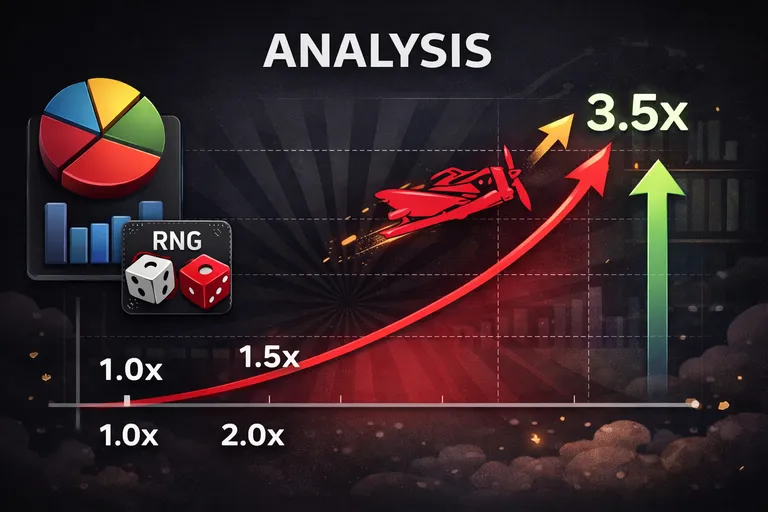
Scroll back a few dozen rounds and you will spot clumps of lows, a few long flat stretches, and the occasional spike that hijacks attention. None of that makes a tall multiplier “due”. Past rounds help you feel variance, pace, and your own habits. They are not a forecast engine for the next crash.
Outcome Comparison: Hitting the Target, Missing It and Chasing History
The table is for thinking, not for crystal balls. Same random shell each time — different player choices inside it.
| Scenario | Your plan | Result | What it shows |
|---|---|---|---|
| Target hit | You set auto cash-out at 1.60x | Round reaches 2.10x | Your plan was reached, so the round becomes a controlled win |
| Target missed | You aim for 2.50x | Round crashes at 1.23x | The round never reached your target, so the stake is lost |
| History chase | You raise the target after a streak of low rounds | Round crashes at 1.50x | Recent history did not make a bigger multiplier any more likely |
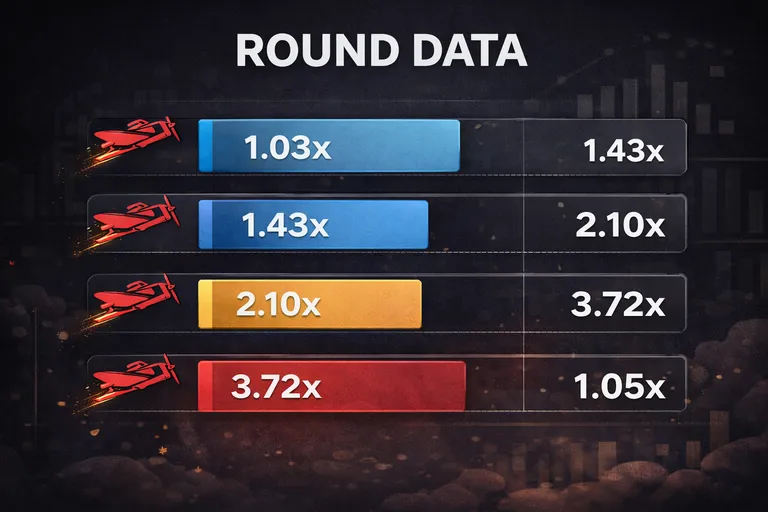
Mathematical and Data Perspective
In the usual Aviator setup, RTP sits at 97%. The house keeps roughly three cents of every theoretical dollar over a giant pile of bets. One short session can land anywhere; the percentage describes the long slope, not tonight’s graph.
Lower cash-out targets hit more often; stretch targets hit less. The baked-in edge does not move. What swings is variance — how gentle or violent the ride feels.
Aviator vs Other Casino Games
| Factor | Aviator (crash) | Slots | Roulette |
|---|---|---|---|
| Typical RTP / house edge | 97% RTP / 3% edge | Usually 95-98% RTP | About 97.3% RTP on European roulette |
| Round speed | Very fast (seconds) | Medium | Slower |
| Player control | Cash-out timing and optional auto cash-out | None after spin | Bet placement only |
| What history is useful for | Variance and target review | Mostly session tracking | Mostly result logging |
Honest trackers and “Aviator analysis” panels still earn their keep. They map multiplier bands, show how often your chosen exit would have cleared inside a sample, and stack your guesses against reality. They will never print the next crash in advance. Licensed venues, readable RTP notes, and provably fair or audited math beat every secret-pattern sales page.
Conclusion and FAQ
Strong Aviator analysis skips the hunt for a magic signal. It locks onto probability, treats history as context, and picks limits that match a game measured in seconds.
Keep the feed in that frame and the “hidden cycle” ads get very boring, very fast.
What does 97% RTP mean in Aviator? It means that over a very large number of bets, the theoretical return to players is 97%, while the built-in house edge is 3%. It does not guarantee what happens in a short session.
How should I read Aviator round history? Use it to study variance, streaks, and how often certain targets were reached across a sample. Do not use it as proof that the next round is predictable or that a high multiplier is overdue.
Can analysis tools predict the next multiplier? No. Helpful tools can visualise past outcomes, but past rounds remain independent. Any tool that claims to know the next crash point should be treated with caution.